
Very Low Testosterone and Mortality: What an IPD Meta-Analysis Shows
Across ~25,000+ community men, very low testosterone was linked to higher risk of death. Plain-English summary of Ann Intern Med (2024). DOI cited.
Last reviewed 2026-10-04 by Jack Mayeux, APRN, FNP. This page is clinical content and is reviewed on a regular schedule.
Medically reviewed by Jack Mayeux, FNP
Across ~25,000+ community men, very low testosterone was linked to higher risk of death.
This article walks through the Ann Intern Med (2024) (https://doi.org/10.7326/M23-2781) paper in plain English: what was studied, what changed, what the limits are, and what it does not prove. Full citation and DOI link (https://doi.org/10.7326/M23-2781) are at the end, with a PubMed record (https://pubmed.ncbi.nlm.nih.gov/38739921/).
What the study found
This 2024 Annals of Internal Medicine study combined individual data from nine prospective cohorts of community-dwelling men (255,830 participant-years) with summary data from 11 more studies (n=24,109). Hormones were measured by mass spectrometry, and men were followed for at least five years.
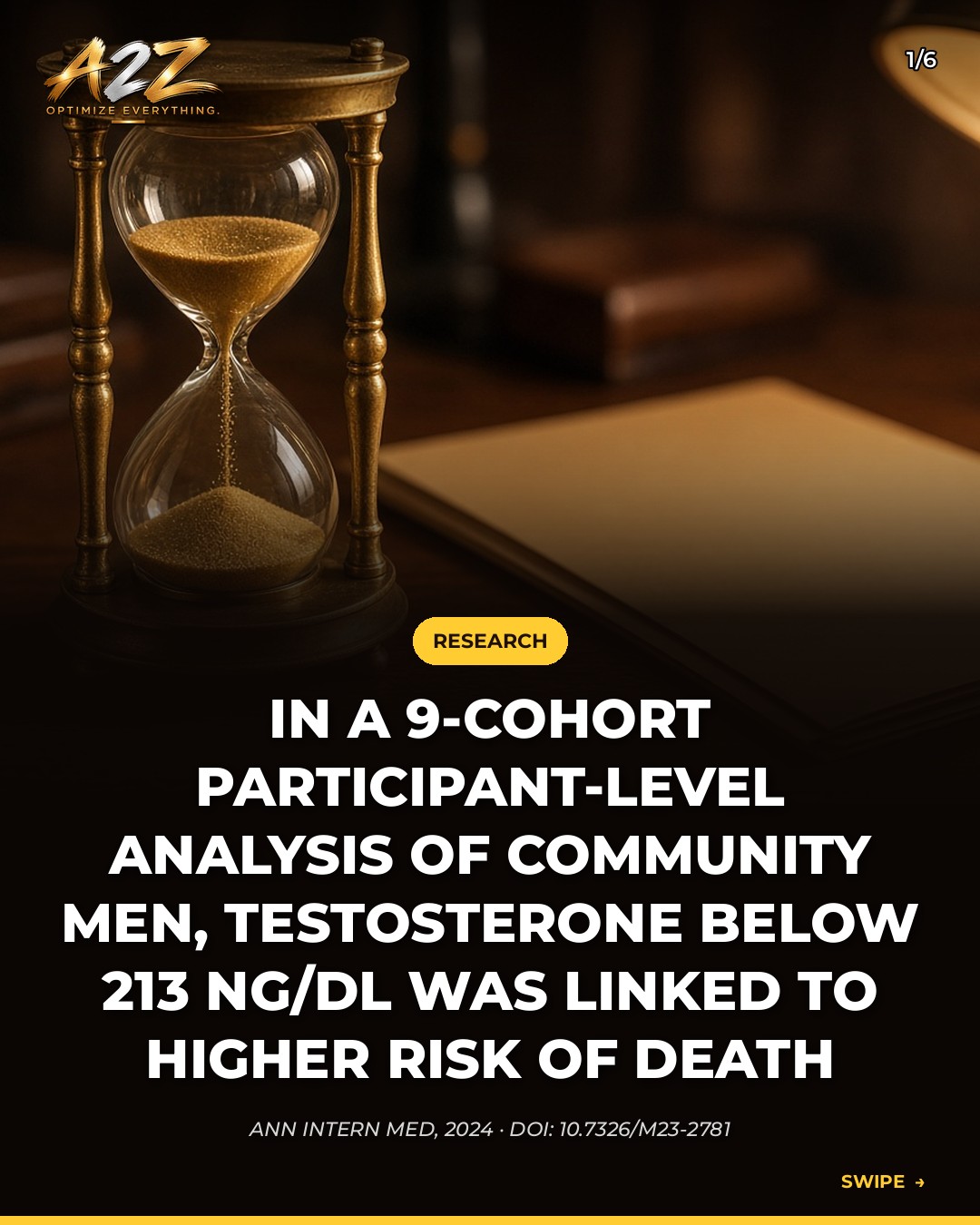
Men with baseline testosterone below 7.4 nmol/L (213 ng/dL) had higher all-cause mortality, and those below 5.3 nmol/L (153 ng/dL) had higher cardiovascular mortality. The study looked at natural hormone levels, not treatment, so it does not show that raising testosterone changes survival.
Key finding (from the study record): Men with T <7.4 nmol/L (<213 ng/dL) had higher all-cause mortality; T <5.3 nmol/L (<153 ng/dL) higher CV mortality (mass-spectrometry measured).
How the study was done
• Design: Individual participant data meta-analysis of prospective cohorts • Who was studied: 9 IPD studies (255,830 participant-years) + 11 studies (n=24,109) • Journal / year: Ann Intern Med (2024) • First author: Yeap BB et al.
From the abstract: BACKGROUND: Whether circulating sex hormones modulate mortality and cardiovascular disease (CVD) risk in aging men is controversial. PURPOSE: To clarify associations of sex hormones with these outcomes. DATA SOURCES: Systematic literature review to July 2019, with bridge searches to March 2024.
What it means — and what it does not
Useful takeaway: Across ~25,000+ community men, very low testosterone was linked to higher risk of death.
Limits and caveats: About low T levels, not TRT - does not show treatment lowers mortality. Observational, heterogeneous. Industry co-funding (Lawley).
This evidence can inform a conversation with a licensed provider. It is not a guarantee of similar results for you, and it is not a recommendation to start, stop, or change any medication on your own.
How this connects to care
A2Z serves men in Utah with telehealth evaluation, labs, and provider-guided plans when appropriate. The TRT program is $149/month and includes initial labs only. Tadalafil and enclomiphene, sermorelin, and tirzepatide (compounded, not FDA-approved) are separate products.
Relevant pages on this site:
• TRT program (https://a2ztrt.com/trt)
FAQ
What did this study actually find?
Across ~25,000+ community men, very low testosterone was linked to higher risk of death. The design was: Individual participant data meta-analysis of prospective cohorts. Population: 9 IPD studies (255,830 participant-years) + 11 studies (n=24,109).
Does this mean I should start treatment?
No. Research informs care; it does not prescribe it. A licensed provider reviews your symptoms, labs, and history before any decision. Results vary.
What are the main limits of this evidence?
About low T levels, not TRT - does not show treatment lowers mortality. Observational, heterogeneous. Industry co-funding (Lawley).
Keep reading
• TRAVERSE Anemia Substudy: TRT, Hemoglobin, and Energy in Men With Low T (https://a2ztrt.com/post/traverse-anemia-energy) • What Is a Normal Testosterone Level, Really? (https://a2ztrt.com/post/what-is-a-normal-testosterone-level) • Can You Drink Alcohol on TRT? What Men Should Know (https://a2ztrt.com/post/can-you-drink-alcohol-on-trt) • Does TRT Cause Hair Loss? What the Evidence Actually Says (https://a2ztrt.com/post/does-trt-cause-hair-loss)
Practical questions to bring to a consult
Research is most useful when it turns into better questions:
• Do my symptoms and labs line up with the kind of men this study enrolled? • Which of the study’s limits apply to me (age, heart risk, anemia, fertility goals, medications)? • What monitoring would we use if we tried a related therapy — hematocrit, PSA, glucose, sleep, or something else? • Are we talking about a branded FDA-approved medication, a different formulation, or a compounded product that is not FDA-approved?
A short, honest consult is the right place for those answers — not a social post. Start a free consult in Utah (https://a2ztrt.com/contact).
Reference
Yeap BB et al. Associations of Testosterone and Related Hormones With All-Cause and Cardiovascular Mortality and Incident Cardiovascular Disease in Men : Individual Participant Data Meta-analyses. Ann Intern Med. 2024. https://doi.org/10.7326/M23-2781 (https://doi.org/10.7326/M23-2781) · PubMed 38739921 (https://pubmed.ncbi.nlm.nih.gov/38739921/).
Next step
Start a free consult in Utah (https://a2ztrt.com/contact). Bring your questions — including anything this study raised for you.
The TRT program is $149/month and includes initial labs only. Tadalafil and enclomiphene, sermorelin, and tirzepatide (compounded, not FDA-approved) are separate products.
Talk to a licensed provider. Results vary. Not medical advice.
Learn more about this topic:
Read the low testosterone symptoms guideTalk to a Utah provider
A2Z is telehealth TRT for Utah men: $149/month, or as low as $119/mo billed $357 quarterly. The first video consult is free, initial labs through Quest Diagnostics are included, and follow-up labs are $74 when your provider orders them. Nothing is prescribed without labs and a provider review.
Related pages